
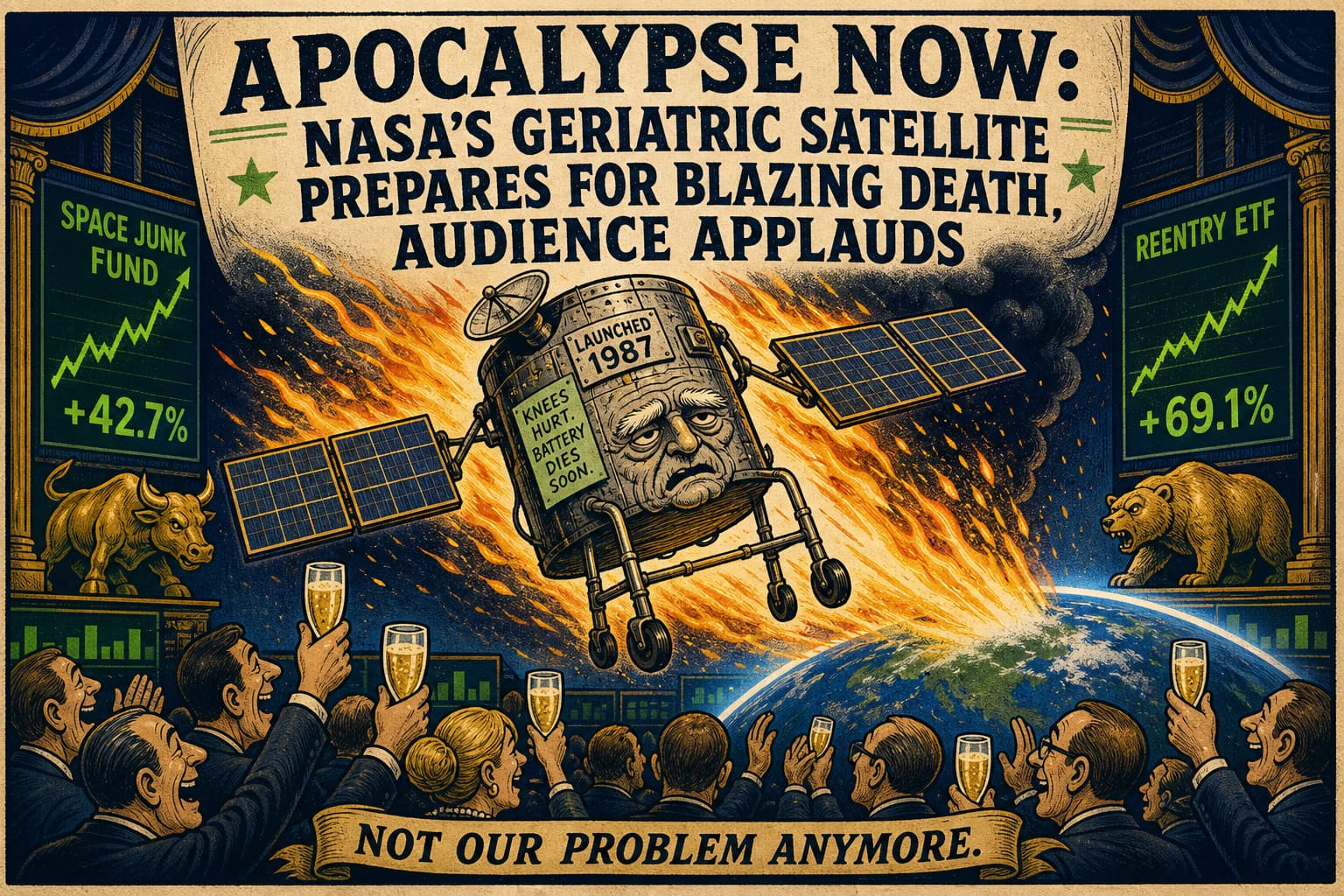
A Satellite Falling Out of Orbit Embarks on Its Final Mission: NASA’s Wildest Quiz Show Yet
By Gordon
Space—famously described as “that big, black bit above the clouds” by absolutely no one credible—has witnessed countless feats of daring, but none as bold as NASA’s latest attempt to play god with an aging, grumpy satellite determined to take up a spontaneous second career as a shooting star.
Picture the scene: the Neil Gehrels Swift Observatory, a scientifically hardworking satellite with more mileage than your Uncle Gary’s 1993 Ford Fiesta, suddenly starts to dip out of orbit. Instead of embracing a gentle retirement of gazing wistfully at nebulae and reminiscing about gamma-ray bursts past, Swift becomes the cosmic equivalent of a pensioner riding a runaway stair lift down Mount Everest.
Enter NASA, ever the overambitious overachievers. Their plan? Launch a robotic lifeguard—codenamed LINK, because that sounds cool—like a sort of space-age Nurse Ratched, to go out and forcibly haul the satellite out of its cosmic nosedive. Imagine a giant metal claw machine, but instead of cuddly toys, it’s wrangling multi-million dollar telescopes through zero-gravity slapstick. God bless them for trying.
But fate, as always, is a fan of slapstick. Mere moments into the rescue, LINK—the plucky robot, whose resume includes “expert grabber" and "space’s most unlikely hero”—promptly suffers an existential crisis. Its altitude system goes AWOL, leaving the robot floating in existential despair, probably debating its career choices and why it didn’t just enroll in robotic culinary school instead of astrophysical towing.
With LINK out of commission, Swift’s fate is sealed. The satellite, you see, wasn’t built for pit stops or midlife makeovers. No, Swift hurtles downward, experiencing the orbital equivalent of trying to run a marathon while being gently menaced by a particularly persistent headwind. The increased solar activity has the atmosphere swelling like a pufferfish on espresso, dragging Swift lower with all the subtlety of a cat being given a bath.
But does Swift go quietly? Not a chance. The team on the ground, brimming with the sort of optimism you only get from drinking way too much astronaut coffee, decide it’s time to party like it’s 2099. They crank the satellite back into gear, dust off its telescopes, and throw it a going-away bash worthy of the cosmos—one last chance to peep deep-space drama and photobomb supernovae before going out in a literal blaze of glory.
As Swift skims dramatically ever closer to atmospheric doom, it restarts two of its three telescopes, straining to feast its digital eyes upon whatever cosmic car crashes it can before plummeting like a forgotten sock behind the washing machine. Nobody’s sure if it’ll catch a gamma-ray burst, spot a supernova, or just beam back the universe’s biggest cosmic selfie. The third telescope stays powered down in protest, clearly not a morning instrument.
Researchers, unable to resist the lure of cosmic rubbernecking, vow to squeeze every last photon out of Swift before it finally pulls a Thelma & Louise and dives face-first into atmospheric reentry. The final images may very well include the universe’s equivalent of jazz hands, an exclamation mark on an existence spent hunting celestial fireworks with gusto.
And so, as the ground team readies itself for Swift’s inevitable swan dive, one thing is certain: this satellite, equipped with multiple telescopes and a tragically heroic sense of timing, is leaving the sky in a blaze that would make even the most attention-seeking comet jealous. Bon voyage, Swift. We’ll see you in the next constellation—or at the very least, in the world’s most dramatic meteor shower.
(Engineers stand by, clutching mission logs and coffee thermoses, pondering whether to invent a satellite with actual safety rails next time. Probably not—they do love a good cosmic cliffhanger.)